Your trading playbook for high-probability setups
What is a playbook?
Professional athletes rely on them. Elite performers swear by them. A playbook is what separates deliberate execution from improvised chaos, and it's exactly what most traders are missing.
Most traders float from chart to chart, strategy to strategy, chasing whatever looks promising without any real system backing their decisions. CandlesLog Playbook flips that script.
A Playbook is a collection of specific, high-probability trading setups—not sweeping strategies that try to cover everything, but precise plays built for particular market conditions. Consider it your personal trading library where every entry has a purpose, every rule has a reason, and every setup has been stress-tested by you.
The distinction matters: where most strategies sprawl across multiple scenarios, a Playbook focuses on your best work, the setups you've validated, refined, and trust enough to run repeatedly.
How to build your first blueprint
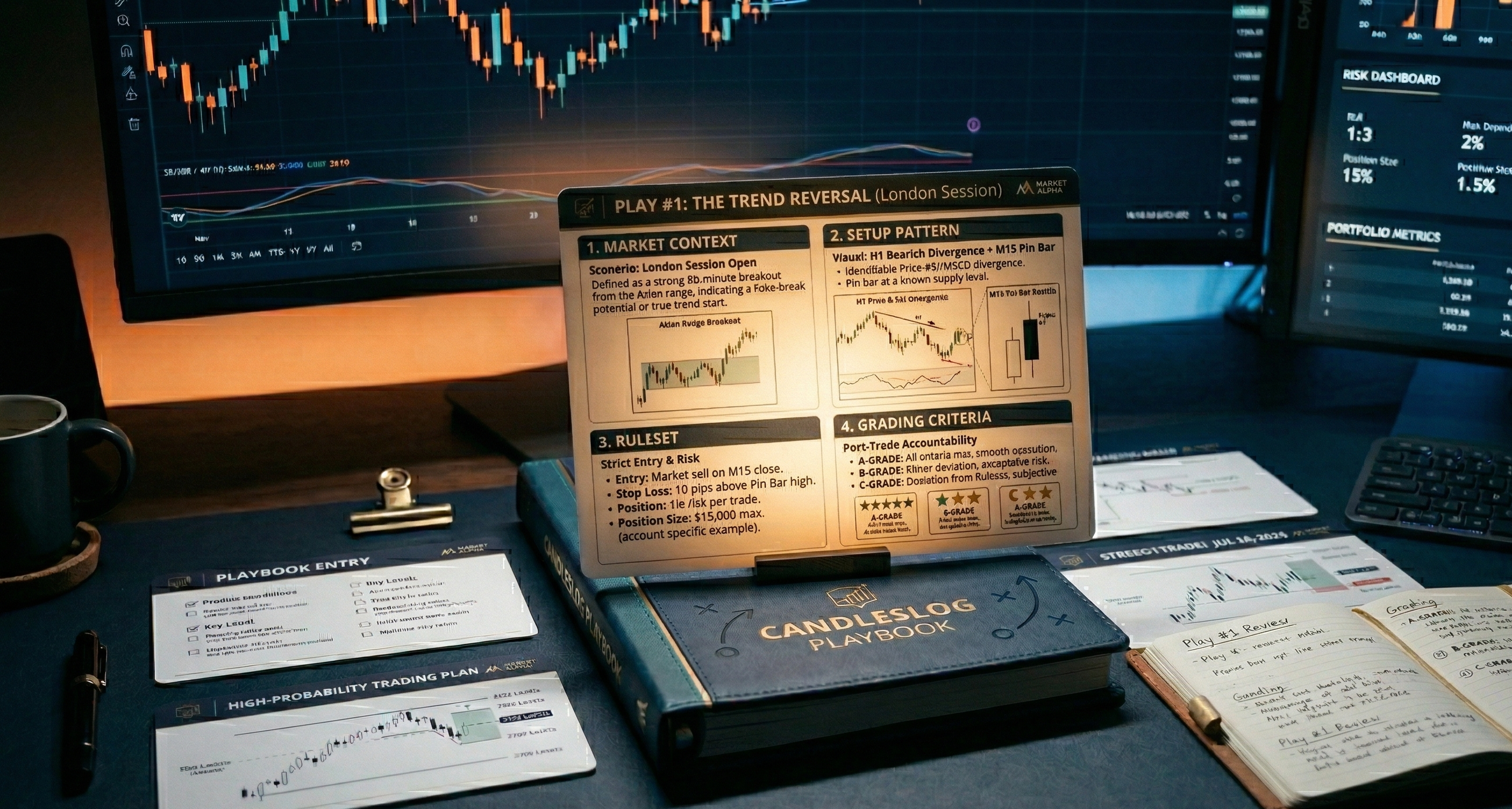
Building a Playbook entry feels a lot like drawing up a play in sports, and for good reason. Each piece connects to form a complete system:
The four pillars of every play
1. Market Context Spell out when this play actually works. Is it for trending markets, range-bound conditions, news events, specific sessions like London or New York? Getting the market context right prevents you from forcing plays into situations where they don't belong.
2. Setup Pattern Describe the exact visual or analytical pattern that catches your eye. This is your "before" state, the conditions that tell you a trade qualifies.
3. Ruleset The hard lines you don't cross. Entry timing, confirmation indicators, position sizing guidelines, maximum risk per trade. Rules remove emotion from the equation and create real accountability.
4. Grading Criteria How will you judge this trade once it's over? Define what separates an A-grade execution from a B or C before you enter, so your review stays objective instead of becoming retroactive excuse-making.
Execution grading: Trade with accountability
This is where Playbook changes the game for your discipline.
After you enter a trade, you move through a confirmation workflow that walks you through some basic questions: Did the market context match my play? Did the setup pattern develop as expected? Did I follow my ruleset precisely? Where did execution go right or wrong?
Then you assign a grade. A means you executed flawlessly. B means good execution with minor deviations. C means significant rule violations or setup failures.
Here's the thing though—this grading isn't about punishment, it's about diagnosis. Look at enough of your grades over time and patterns emerge. Maybe you consistently nail pattern recognition but stumble on exit timing. Maybe your A-grades cluster around certain market conditions. The Playbook surfaces these insights without you having to dig for them.
Anatomy of a playbook entry
Every entry in your Playbook follows the same structure:
| Field | Purpose |
|---|---|
| Name | Something memorable (like "Silver Bullet") |
| Market Context | When this play is valid |
| Setup/Pattern | Exact conditions that qualify |
| Entry Trigger | The precise moment to act |
| Exit Strategy | Profit targets, stop losses, time-based exits |
| Grade | Your execution rating (A/B/C) |
That standardized format means you're never digging through notes trying to remember "that one setup I kind of remember." Everything is documented, searchable, and tracked by grade.
Real-world example: "The Silver Bullet" (ICT methodology)
Let me make this tangible with an actual play.
Name: Silver Bullet Market Context: Low-liquidity overnight session, usually 2:00–4:00 AM EST, during ranging market structure Setup Pattern: Order block confirmation on the 5-minute chart, Fair Value Gap visible, institutional sentiment aligned Entry Trigger: Aggressive close above the 5-minute low with volume confirmation Exit Strategy: First target at the opposing order block, stop placed at the 5-minute high minus a buffer Grading Criteria: A-grade requires entry within 2 ticks of the trigger, full position size, and stop never exceeded. B-grade allows acceptable slippage or partial position. C-grade means you chased the entry or violated a rule.
This isn't some vague "fade the move" strategy floating in abstract space. It's a specific play with verifiable criteria, measurable execution, and a built-in review system that tells you whether you actually did what you said you'd do.
Why playbooks transform trading performance
Filter for Quality Your Playbook becomes a quality filter. When a potential trade doesn't match any existing play, it doesn't qualify. This single change cuts out a massive source of losses—the "almost good enough" trades that slip through and erode your capital.
Enforce Discipline Every entry connects to a ruleset. Every trade gets graded. You can't rewrite history about whether you "should have" entered differently because the Playbook sets the standard before emotion gets involved.
Stop Over-Trading With a finite set of pre-approved plays, you naturally trade less but better. Fewer, higher-quality setups outperform a high-volume approach that floods your account with costs and emotional damage.
Build a Feedback Loop Graded trades generate real data. Over weeks and months, your Playbook becomes a living record of what actually works for your trading style, in your market conditions, executed your way.
Ready to build your first playbook?
CandlesLog makes it straightforward to start documenting your best setups, grading your executions, and building a systematic approach that grows alongside your experience.
Your next trade could be your first graded play.
Start with three plays. Master them. Grade every execution. Watch your consistency transform.
Ready to Put This Into Practice?
CandlesLog is free. Start your trading journal today and apply what you've learned.
Start Free Journal